

Dear Clients
Here is our view on the recent geopolitical developments, particularly the escalation of conflict in the Middle East which has caused increased volatility across global financial markets.
Similar to previous volatility events we continue to urge our clients to:
- Understand their Wealth Plan and stay the course.
- Resist the desire to time the market by hopping in and out.
- Contact us if you would like to discuss your specific circumstances and any changes we should be aware of.
The Iran Conflict
Equity markets have experienced short-term declines, while oil and gas prices have risen as investors assess the potential economic impacts of the situation.
At this stage speculation on the effects on oil prices is at its height as there is currently a stoppage of 20% of the world’s oil supply which passes through the Hormuz straight near Iran. At present it is too early to tell if this will resolve quickly or not.
Volatility Is a Normal Part of Investing — Stick to Your Wealth Plan
We understand that periods like this can feel unsettling, it’s important to remember that market volatility is a normal part of investing.
Geopolitical events often trigger short-term market reactions as investors respond to uncertainty. Historically, however, markets have tended to stabilise as more information becomes available and investors refocus on economic fundamentals and long-term growth trends.
Stay the Course and Stick to Your Wealth Plan
1. VJC Wealth construct your Wealth Plan to suit your needs
Your investments should reflect the objectives of your Wealth Plan, taking into account your timeframe, risk tolerance, and appropriate diversification.
A well-diversified portfolio is designed to help manage periods like these. Different asset classes and sectors may respond differently to global events, helping to balance overall investment performance.
This diversification, combined with a disciplined long-term approach, is a key part of navigating market cycles.
While headlines can drive short-term volatility, the most successful investment strategies are typically those that remain focused on long-term goals rather than reacting to short-term market movements.
2. When Markets Fall, Ill‑Advised Investors Often Think They Should Exit
Trying to time the market—moving in and out of investments during periods of volatility—can be extremely difficult to do successfully. In fact, most people do not get it right.
Attempting to time the market by switching into lower-risk investments, such as cash, may feel safer in the moment, but it can significantly limit long-term growth compared with remaining invested.
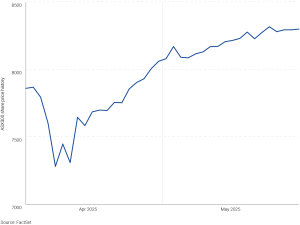
History also shows how quickly markets can recover. For example, on 3 April 2025:
- Share markets in Australia and around the world fell sharply following the announcement of new tariffs on imported goods by the United States.
As the chart below shows, the Australian share market rebounded quickly, recovering lost ground just a few weeks later.
If you switched out of shares during the market fall and kept your money in cash, you might have missed out on significant growth.
Investors who stayed the course and remained invested through April and May benefited from an 8–9% rebound from the lows at the start of April, followed by another 3–4% gain in May.
How the Australian Share Market Rebounded After April’s Tariff Falls
3. Markets React Temporarily to Events
Short‑term market movements are often driven by sentiment and media headlines rather than by lasting changes to underlying economic fundamentals.
While geopolitical tensions can create temporary disruptions, markets have historically demonstrated resilience over time.
4. Waiting for “Certainty” Before Investing Can Be Detrimental
Markets are forward‑looking and often begin to recover before broader news flow and sentiment improve.
Waiting for greater clarity can result in missing the early stages of a market recovery.
For investors who feel uncertain during periods of volatility, dollar‑cost averaging can be one way to manage concerns by spreading investment decisions over time.
As always, if you have any questions about recent market developments or your investment strategy, please feel free to contact our team.
Important Notice
The information contained in this article is general in nature only and does not take into account your personal objectives, financial situation or needs. You should consider whether the information is appropriate for your circumstances before acting on it and seek advice from a qualified professional.
Personal financial advice can only be provided after considering your individual circumstances and providing the appropriate disclosure documentation. VJC Wealth accepts no liability to any party for any loss arising from reliance on this information unless it has been provided as part of a formal advice engagement.